
Most Meta Ads accounts do not have a targeting problem. They have a creative problem that looks like a targeting problem. CPMs creep up, CTR slides, CPL doubles — and the instinct is to rebuild audiences, when the real issue is that the same two ads have been shown to the same people for six weeks.
In 2026 this matters more than ever. Meta’s delivery system now leans heavily on the creative itself to decide who sees your ad, which means the ads you make are your targeting. That changes what “testing” should look like: not a blue button against a red button, but structured experiments across concepts, formats and hooks — with a clear refresh system once winners start to tire.
This guide gives you that system. We cover what static, video, carousel and Reels each do best, which ones tend to win for which business goal, how to set up a clean test in Ads Manager, how to read the results, and how to refresh creative before fatigue eats your ROAS. It is the same testing logic we build into every Meta Ads management retainer at Harmukh Technologies — and it works best when your tracking is already solid, so if you have not verified your Meta Pixel and Conversions API setup, start there.
Quick answer: No single format wins on Meta in 2026 — the concept wins, and the format decides how cheaply that concept scales. Short vertical video usually leads for cold reach and Reels placements, carousels tend to win when you have several products, proof points or steps to show, and static images remain the cheapest, fastest way to test new angles and close warm audiences. The winning approach is to test concepts first, formats second, hooks third — then scale winners in a separate campaign and refresh every 2–4 weeks before frequency and CPA climb.
Jump to a section
- Why creative is the main lever on Meta in 2026
- What static, video, carousel and Reels each do best
- What wins in 2026: format by business goal
- The four-phase creative testing framework
- How to set up the test in Ads Manager
- How to read results and decide: kill, hold or scale
- Creative fatigue: how to spot it early
- The creative refresh playbook
- Testing creative for warm and retargeting audiences
- India-specific creative notes
- Common creative testing mistakes
- FAQs
01. Why Creative Is the Main Lever on Meta in 2026
Creative is now the main lever because Meta’s delivery system reads your ad’s content visuals, hook, message, format to decide which people are most likely to respond. Industry commentary on Meta’s Andromeda delivery update describes the same shift: audience targeting has loosened, and creative variety has become the signal the system works with. When every ad in your account says the same thing in the same way, the system has very little to match against different people, and CPMs and costs tend to rise.
What this means in practice:
- Different formats are not different concepts. Turning the same message into a video, a static and a carousel is a format test. It is useful, but it does not give the system a genuinely new angle to work with.
- Broad audiences are viable, but only with varied creative. Broad targeting plus one or two ads is a fragile setup. Broad targeting plus several distinct concepts is a healthy one.
- Fatigue arrives faster. Short-form video in particular burns through audiences quickly; some 2026 industry data puts average video ad fatigue at under ten days. Treat that as a directional warning rather than a rule for your account — your own frequency and CTR data decide when to rotate.
The shift in one line: in the old playbook you found the right audience for your ad. In the current one, you build the right ad variety and let delivery find the audience.
None of this removes the need for good structure and clean data. It just moves the highest-leverage work to the creative brief. If you are also running a warm-audience layer, our guide to the Meta Ads retargeting funnel shows how creative should change by funnel stage.
02. What Static, Video, Carousel and Reels Each Do Best
Each format does a different job: static is the fastest and cheapest to test, video builds attention and trust, carousel shows breadth or sequence, and Reels is a vertical, full-screen environment that rewards video made for it. One clarification first — Reels is a placement, not a creative type. It is where vertical video is served, so “video vs Reels” is really “video made for the feed vs video made for full-screen vertical.”
| Format | Best at | Watch out for | Best funnel stage |
|---|---|---|---|
| Static image | Fast, low-cost concept testing; clear offers; price or benefit-led messages; closing warm audiences | Easily ignored in a busy feed; the headline and visual must do all the work | Concept testing, MOFU and BOFU |
| Short video (under 30 sec) | Stopping the scroll; showing a product or result in use; founder, UGC-style and testimonial content | Weak first three seconds; fastest to fatigue; costlier to produce | TOFU and MOFU |
| Carousel | Multiple products or services, step-by-step explanation, before-and-after, several proof points | Cards after the first get fewer views, so lead with the strongest card | MOFU, plus catalogue-style retargeting |
| Reels (vertical 9:16 video) | Cheap incremental reach among younger, mobile-first audiences; native-feeling, unpolished content | Over-produced or horizontal creative looks out of place; captions and safe zones matter | TOFU, and top-layer retargeting |
A useful rule: choose the format by the job the ad has to do, not by what is easiest to produce. If the job is “show six room types at a hotel,” a carousel does it better than any video. If the job is “make a cold viewer feel they can trust us in five seconds,” a person speaking to camera usually beats a polished graphic. For a wider look at what each format supports and how it is configured, see our breakdown of the types of Meta Ads.
03. What Wins in 2026: Format by Business Goal
Video most often wins for cold reach and awareness, carousels for multi-product or multi-benefit offers, and static for fast testing and bottom-funnel closing — but your own data should always overrule these defaults. The table below is a starting hypothesis for your first test round, based on how these formats generally behave across the account types we manage, not a guarantee.
| Business type | Start testing with | Why |
|---|---|---|
| Lead generation for services (clinics, education, consultants) | Testimonial or explainer video + a direct-offer static | Trust and clarity drive enquiries; static lets you test offers and headlines cheaply |
| E-commerce | Carousel or catalogue-style creative + short product video | Shoppers want to compare and see the product in use |
| Tourism and hospitality | Reels-style vertical video + a carousel | Visual immersion and room/experience showcases drive bookings |
Lead generation for services (clinics, education, consultants)Testimonial or explainer video + a direct-offer staticTrust and clarity drive enquiries; static lets you test offers and headlines cheaply
E-commerceCarousel or catalogue-style creative + short product videoShoppers want to compare and see the product in use
Tourism and hospitalityReels-style vertical video + a carousel of itineraries or roomsDecisions are visual and emotional; carousels handle packages and options well
Real estateWalkthrough video + static with a clear location and price hookVideo builds interest, static filters for budget and location
Courses and coachingFounder-led video + proof-based carousel (results, syllabus)Credibility and outcomes matter more than polish
Two honest caveats. First, any benchmark you read about video beating carousel by a set percentage comes from a particular set of accounts, industries and time windows — useful context, but not your numbers. Second, a strong concept in a weaker format will usually beat a weak concept in the “best” format. That is why the framework below tests concepts before formats.
04. The Four-Phase Creative Testing Framework

The framework tests in a fixed order — concept, then format, then hook, then scale — because the earlier variables move results far more than the later ones. Changing everything at once makes it impossible to know what worked. Changing things in order lets each phase build on the last.
Phase 1: Concept testing — find the angle that resonates
A concept is the core idea of the ad: the problem you lead with, the promise you make, the proof you use. Build three to five clearly different concepts and run them in the same format so the angle is the only thing that varies. For a Kashmir tour operator, three genuinely different concepts might be “the hidden-itinerary angle,” “the hassle-free family trip angle” and “the price-transparent package angle.” For a clinic: “symptom awareness,” “doctor credibility,” and “patient result.”
Static images are the cheapest vehicle for this phase. You are testing the idea, not the production value.
Phase 2: Format testing — adapt the winning concept
Take the one or two strongest concepts and rebuild them as a short video, a carousel and, where relevant, a vertical Reels cut. Now the format is the only thing changing. Some concepts that look average as a static come alive in motion; others lose their punch when stretched into video. This phase tells you which format your concept is most efficient in — and gives Meta a deliberately varied pool for delivery.
Phase 3: Hook testing — win the first three seconds
With a winning concept and format, test different openings: a question, a bold claim, a visual pattern-break, a result shown first, a customer’s voice. For video, this means the first three seconds. For static, it means the headline and the dominant visual. Hook tests are the cheapest improvement you can make to a creative that already works, because the body of the ad stays the same.
Phase 4: Scale and refresh — graduate winners, retire tired ads
Move proven creative into a separate scaling campaign, keep the testing campaign running with new ideas, and set a refresh trigger based on frequency and performance, not on the calendar alone. Section 08 covers the refresh playbook in full.
Order of testing, in short: Concept → Format → Hook → Scale and refresh. Skip ahead and you will be optimising details of an idea that was never the right one.
05. How to Set Up the Test in Ads Manager
The cleanest setup is a dedicated testing campaign, separate from your scaling campaign, with each concept or format in its own ad (or ad set) and enough budget for every variant to gather meaningful data. Mixing tests into your main campaign lets a single high-spending ad swallow the budget before the others get a fair run.
A simple structure that works
- Testing campaign: one broad audience, one conversion goal, and three to five ads per round — each ad a different concept (Phase 1) or a different format of the same concept (Phase 2).
- Scaling campaign: your proven winners, running with a larger share of budget. A common starting split is roughly 70% scaling and 30% testing, adjusted to how aggressively you need new creative.
- Native testing tools: Meta’s built-in creative testing and A/B test features can compare a small number of variants without disturbing the rest of the account. They are useful for clean comparisons, but check their current limits in Ads Manager before relying on them.
How much budget does each variant need?
A practical working rule: give each test cell enough budget to produce roughly 10–20 of your target conversions before you judge it. This is a pragmatic guideline, not a Meta requirement — Meta’s own learning phase expects far more volume (around 50 conversions per ad set per week). If a lead costs you ₹400, that is about ₹4,000–₹8,000 per variant. If a round of four ads would cost more than you can spend, run fewer variants rather than starving all of them.
Naming convention: make results readable at a glance
Use a consistent format so you can filter and compare without opening every ad. For example:
CONCEPT_FORMAT_HOOK_DATE → PriceTransparent_Carousel_Hook2_Oct26
That one habit makes your weekly review ten minutes shorter and your learnings searchable months later.
Keep the rest of the setup stable
Change only the creative variable you are testing. Keep audience, placement settings, optimisation event, landing page and budget logic the same across variants, otherwise you are measuring several things at once. And make sure your conversion events are firing correctly before you spend; a creative test on faulty data produces confident wrong answers.
06. How to Read Results and Decide: Kill, Hold or Scale
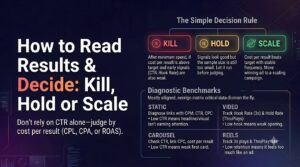
Judge each creative on the metric that matches its job, but make the final call on cost per result — CPL, CPA or ROAS — not on CTR alone. A high-CTR ad that attracts the wrong clicks is a worse ad than a modest-CTR one that produces qualified leads.
| Format | Diagnostic metrics | What a weak number usually means |
|---|---|---|
| Static | CPM, CTR (link), CPC | Low CTR: headline or visual is not earning attention. High CPM: creative has low resonance or narrow appeal. |
| Video | Hook rate (3-second plays ÷ impressions), hold rate (ThruPlays ÷ 3-second plays) | Low hook rate: weak opening. Good hook but low hold: the middle loses momentum. |
| Carousel | CTR, cost per link click, cost per result | Low CTR: first card is weak. Good CTR but poor results: cards are interesting but offer is unclear. |
| Reels | 3-second plays, ThruPlay rate, cost per result | Low retention: creative feels like an ad rather than native content. |
A simple decision rule
- Kill: after it has reached your minimum spend threshold, its cost per result is clearly above target and its leading indicators (hook rate, CTR) are also weak.
- Hold: early signals look good but the sample is still small. Let it run before judging.
- Scale: cost per result beats target with stable frequency. Move it into the scaling campaign rather than raising the budget inside the test.
If you are unsure which cost metric should lead your decision for a given goal, our explainer on CPL vs CPA vs ROAS covers when each one matters, and the PPC campaign metrics guide lists the formulas and benchmarks. When costs start rising without an obvious cause, work through our Meta Ads CPL optimisation guide before you change the creative.
Illustrative example: a clinic tests three concepts as static ads for a week. “Doctor credibility” earns a similar CTR to the others but a clearly lower cost per lead. In Phase 2 it is rebuilt as a 20-second doctor-to-camera video and a three-card carousel. The video wins on cost per lead, so Phase 3 tests three different opening lines on that video. The best hook goes to the scaling campaign. (Figures here are illustrative only; your results will differ.)
07. Creative Fatigue: How to Spot It Early

Creative fatigue shows up as rising frequency, falling CTR and climbing CPA — usually in that order — so frequency and CTR trends warn you before cost per result does. By the time CPA has clearly worsened, you have already been overpaying for days.
| Signal | What you will see | Typical action |
|---|---|---|
| Frequency climbing | The same people are seeing the ad repeatedly; for small or warm audiences, watch out | Add a new variant; broaden or refresh the audience |
| CTR declining | Week-over-week drop in link CTR on a previously healthy ad | Swap the hook or visual (light refresh) |
| CPM rising | You are paying more for the same reach | Check creative variety across the account, not just the one ad |
| CPA / CPL rising | Cost per result drifts above target with no tracking or landing page issues | Rotate in a new concept (deeper refresh) |
Frequency climbingThe same people are seeing the ad repeatedly; for small or warm audiences this happens fastAdd a new variant; broaden or refresh the audience
CTR decliningWeek-over-week drop in link CTR on a previously healthy adSwap the hook or visual (light refresh)
CPM risingYou are paying more for the same reachCheck creative variety across the account, not just the one ad
CPA / CPL risingCost per result drifts above target with no tracking or landing page changeRotate in a new concept (deeper refresh)
For retargeting ad sets, the thresholds are tighter because the audiences are smaller. Our retargeting funnel guide suggests rotating creative when frequency passes about 3.0 and pausing or expanding the audience around 5.0 a good baseline for warm audiences specifically.
08. The Creative Refresh Playbook

Refresh in three levels — a hook swap, a format remix, or a brand-new concept — and match the level to how severe the fatigue is. Most teams jump straight to “make new ads,” which is slow and expensive. A tiered approach gets you a fresh-feeling ad in a fraction of the time.
| Level | What you change | Use when | Effort |
|---|---|---|---|
| Level 1: Hook swap | New opening line, thumbnail, first three seconds or headline; body stays | CTR is slipping but cost per result is still fine | Low |
| Level 2: Format remix | Same concept rebuilt as a different format (static to video, video to carousel, feed cut to 9:16) | A concept still converts but the creative looks stale | Medium |
| Level 3: New concept | A genuinely new angle, proof point or audience pain | Cost per result is rising and the concept itself is exhausted | High |
Level 1: Hook swap New opening line, thumbnail, first three seconds or headline; body staysCTR is slipping but cost per result is still fineLow
Level 2: Format remix Same concept rebuilt as a different format (static to video, video to carousel, feed cut to vertical Reels)A concept still converts but the creative looks staleMedium
Level 3: New concept A genuinely new angle, proof point or audience painCost per result is rising and the concept itself is exhaustedHigh
A four-week refresh rhythm
| Week | Focus |
|---|---|
| Week 1 | Launch a new concept round in the testing campaign (3-5 ads) |
| Week 2 | Review early signals, kill clear losers, begin format or hook iterations on promising angles |
| Week 3 | Graduate proven winners to the scaling campaign; check frequency and fatigue on active ads |
| Week 4 | Retire fatigued ads, log learnings in the creative tracker, brief next month’s batch |
Week 1 Launch a new concept round in the testing campaign (3–5 ads)
Week 2 Review early signals, kill clear losers, begin format or hook variants on likely winners
Week 3 Graduate proven winners to the scaling campaign; check frequency on existing ads
Week 4 Retire fatigued ads, log learnings in the creative tracker, brief the next round
Short-form video may need a faster cycle than static, and small retargeting audiences may need rotation every couple of weeks. Let frequency and CTR set the real timing. This is exactly why creative refresh cycles are built into our Meta Ads engagement rather than sold as an add-on — if you want a team running that rhythm for you, see how our Meta Ads management service works.
Keep a creative log
Record every test: concept, format, hook, spend, key metrics, verdict and one-line learning. After a few rounds you will have a library of what works for your audience, which makes every new brief sharper and every future agency or freelancer handover easier.
09. Testing Creative for Warm and Retargeting Audiences
Warm audiences respond to proof, specifics and a clear next step, so test objection-handling angles and direct offers rather than more brand awareness. The principle from cold creative still applies — vary the concept, not just the colours but the angles change. Test price clarity, testimonials from similar customers, “what happens after you enquire,” and offer-led statics against each other.
Static and short testimonial video tend to be efficient here, while carousels work well for showing a range of services or products someone has not yet seen. Because warm pools are small, expect to refresh faster and keep at least three variants running together. The full layer-by-layer logic is in our Meta Ads retargeting funnel guide.
10. India-Specific Creative Notes
For Indian audiences, design for mobile first, add captions to every video, and consider Click-to-WhatsApp as a conversion path when the goal is enquiries. Most of your audience will see ads on a phone, often with sound off, so these practical choices tend to matter more than production polish:
- Vertical first. Build 9:16 versions of your best video, and keep text and logos inside the safe zones so interface elements do not cover them.
- Captions on everything. Many people watch without sound. Burned-in or well-timed captions protect your message.
- Language as a test variable. English, Hindi or a regional language can change response noticeably depending on your audience. Test it like any other concept variable instead of assuming.
- WhatsApp as the call to action. For service businesses, tourism and clinics, an ad that opens a WhatsApp conversation can feel lower-commitment than a form. Test it against your standard lead form.
- Seasonality. For Kashmir tourism and hospitality in particular, refresh creative around season changes, festivals and weather shifts — an ad built for summer fatigues quickly as demand moves.
- Fast landing pages. A winning creative on a slow, desktop-first page wastes the click. Test the page alongside the ad.
Brand consistency matters here too. Testing many concepts is fine, but every variant should still look and sound like your brand — a clear identity makes new ads feel familiar and trustworthy. If your visual identity is not yet defined, our branding service and content marketing service cover the foundation that makes creative production faster and more consistent.
11. Common Creative Testing Mistakes
- Testing format swaps and calling them new concepts. Three versions of the same message are one concept in three wrappers.
- Changing too many variables at once. If the hook, format and audience all changed, you cannot say what caused the result.
- Judging too early. Pulling an ad after a couple of days and a handful of clicks kills potential winners on noise.
- Letting tests run inside the scaling campaign. One ad takes the budget and the rest never get a fair chance.
- Optimising for CTR alone. Clicks are a leading indicator; leads, sales and ROAS decide the verdict.
- Never refreshing winners. A great ad is not permanent. Scale it, then plan its replacement.
- Ignoring the landing page. A creative test can look like a loser when the page is the real problem.
- No creative log. Without records, you repeat old tests and forget what already failed.
12. The Framework at a Glance

| Phase | What you test | Best format to use | Success signal |
|---|---|---|---|
| 1. Concept | 3-5 different angles | Static (cheap, fast) | Lowest cost per result for equal spend |
| 2. Format | Winning concept as video, carousel, Reels cut | Whichever suits the concept | Efficient cost per result with stable frequency |
| 3. Hook | 3 openings on the winning creative | Video and static | Higher hook rate or CTR without worse cost per result |
| 4. Scale & refresh | Move winners to scaling; replace tired ads | Full mix | Stable blended CPA/CPL as budget grows |
1. Concept 3–5 different anglesStatic (cheap, fast)Lowest cost per result for equal spend
2. Format Winning concept as video, carousel, Reels cutWhichever suits the conceptEfficient cost per result with stable frequency
3. Hook 3 openings on the winning creativeVideo and staticHigher hook rate or CTR without worse cost per result
4. Scale & refresh Move winners to scaling; replace tired adsAll of the aboveConsistent CPA/ROAS as frequency climbs
Creative testing is one part of a larger system that includes tracking, audience structure and measurement. If you want to see how it connects to your wider paid strategy, read about our performance marketing approach, and if you also run search campaigns, our Google Ads management service pairs well with Meta for capturing demand that your creative generates.
13. Frequently Asked Questions
Which Meta Ads format performs best in 2026: static, video or carousel?
No format wins everywhere. Video is often strongest for cold reach and Reels placements, carousels tend to suit multi-product or multi-benefit offers, and static images are the cheapest way to test angles and close warm audiences. The concept inside the ad usually matters more than the format, so test concepts first and formats second.
Is Reels a different ad format from video?
Reels is a placement, not a separate creative type. It is a full-screen vertical environment, so video built natively for 9:16 with fast hooks and captions tends to perform better there than repurposed horizontal creative.
How many creatives should I test at once?
Three to five ads per testing round is a practical range for most budgets. More variants only make sense if each one can still gather enough conversions to judge fairly. If budget is tight, run fewer variants with clearer differences between them.
How long should I run a creative test before deciding?
Run each variant until it has spent enough to produce roughly 10–20 of your target conversions, or about a week for most accounts, whichever comes later. Avoid decisions based on a day or two of data, which is mostly noise.
How often should I refresh Meta Ads creative?
Let frequency, CTR and cost per result decide, not the calendar. As a baseline, plan a new testing round every two to four weeks, and rotate warm-audience ads sooner. Short-form video generally fatigues faster than static.
What is the difference between creative testing and creative refresh?
Testing finds out what works by comparing different concepts, formats and hooks. Refreshing replaces ads that have stopped working with new versions of proven ideas, or with new ideas entirely. A healthy account does both continuously.
Can small budgets still do proper creative testing?
Yes, with fewer variants. Test two or three concepts as static ads first, move the winner into video, then test hooks. A smaller, well-structured test beats a large test where no ad gets enough spend to prove anything.
Related reading
- How to Build a Meta Ads Retargeting Funnel That Converts Warm Audiences Into Paying Customers
- Types of Meta Ads: Facebook & Instagram Ad Formats Explained
- Meta Pixel vs Conversions API: What’s the Difference and Why You Need Both
- How to Optimise Your Meta Ads Campaign and Get Your CPL Down
- CPL vs CPA vs ROAS — Here’s Which One Actually Grows Your Business
- PPC Campaign Metrics: Every Metric, Formula & Benchmark You Need (2026)
Want a creative testing system running inside your Meta Ads account?
At Harmukh Technologies, creative strategy, testing rounds and refresh cycles are built into our Meta Ads management — alongside Pixel and Conversions API setup, full-funnel structure and revenue-focused reporting. Tell us what you are running today and we will show you where your creative is leaking budget.